Sponsored article
How Does Recycled Plastic Affect the Stiffness, Material Purity and Performance of Bar Trays?
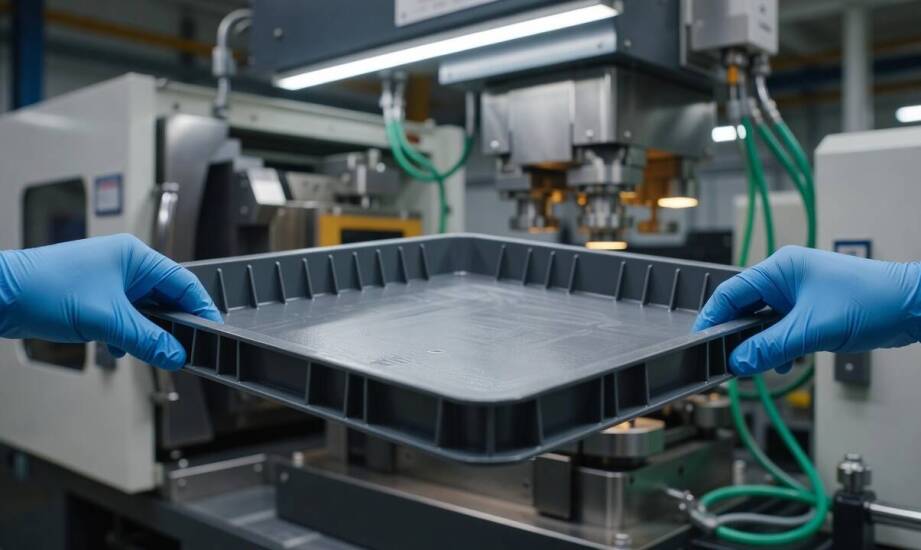
- Are Recycled Plastics Always Less Rigid Than Virgin Materials?
- Why Does Tray Geometry Matter as Much as the Material?
- What Does Recycled Material Change During Injection Moulding?
- Why Is Stable Flow Important for Large Trays?
- How Does Recycled Plastic Affect Shrinkage and Warpage?
- Does Recycled Material Always Mean Lower Chemical Purity?
- Can Recycled Plastic Cause Odour or Colour Differences?
- What About Printing and Brand Customisation?
- How Does Recycled Material Work With Anti-Slip Surfaces?
- How Important Is Cleaning Resistance?
- When Is Recycled Plastic a Good Choice for Bar Trays?
- How Can Batch-to-Batch Repeatability Be Maintained?
- Why Is Functional Testing More Important Than the Recycled-Content Percentage?
- How Does Noex Approach Recycled Plastic Trays?
- Recycled Material Should Be Qualified for the Product, Not Chosen by Label Alone
- FAQ
The growing focus on circular production is increasing the use of recycled polymers in everyday plastic products, including advertising and serving trays.
Read more: Why Does a Flexible-Finger Disc Remove Scale from Sheet Metal Edges After Thermal Cutting?
Replacing virgin resin with recycled material, however, is not simply a matter of changing the granulate in the injection-moulding machine.
The material still has to provide the required:
stiffness;
dimensional stability;
surface quality;
load-bearing behaviour;
colour consistency;
compatibility with printing and decoration;
resistance to the conditions encountered during everyday use.
For a bar tray, these characteristics are particularly important.
A product that looks correct immediately after moulding can still be unsuitable if it bends excessively under a load of bottles, warps after cooling, develops an unwanted odour or behaves inconsistently between production batches.
The performance of recycled plastic therefore depends not only on the percentage of recycled content, but also on where the material comes from, how consistently it is prepared and how well its properties match the product design.
Are Recycled Plastics Always Less Rigid Than Virgin Materials?
No.
Recycled content does not automatically mean lower stiffness.
The mechanical properties of a recycled polymer depend on several factors, including:
the type of polymer;
previous processing history;
contamination;
additives;
fillers;
molecular-weight changes;
the number of recycling cycles;
blending with other grades.
Repeated thermal and mechanical processing can change polymer structure.
For some materials, chain scission can increase melt flow and reduce certain mechanical properties. Other properties may remain sufficiently stable for the intended application.
This distinction is important when designing a tray.
A bartender does not evaluate the polymer by looking at its technical data sheet. What matters during use is whether the tray remains sufficiently rigid when it is lifted with several glasses or bottles distributed across its surface.
A small change in material stiffness can become much more noticeable in a large, flat product than in a compact component.
Why Does Tray Geometry Matter as Much as the Material?
The polymer itself is only one part of the mechanical system.
Tray stiffness also depends on:
diameter or overall dimensions;
wall thickness;
rim geometry;
ribs and reinforcements;
local changes in section thickness;
distribution of the load.
A correctly designed tray can therefore compensate for some differences in material behaviour through geometry.
Conversely, replacing one polymer grade with another without checking the existing design may result in excessive deflection or local deformation.
This is particularly relevant for large rectangular trays, where the distance between the supporting hand and the load can be significant.
Before moving a product to recycled material, the manufacturer should therefore assess the combination of material modulus, component geometry and expected service load, rather than relying on recycled content as the main design criterion.
What Does Recycled Material Change During Injection Moulding?
A recycled grade may have a different processing history from virgin material.
Depending on its source and preparation, this can affect parameters such as:
melt flow rate;
viscosity;
density;
shrinkage;
moisture;
colour;
contamination level.
Melt flow rate, or MFR, is useful for comparing the flow behaviour of material batches, but it should not be treated as the only indicator of quality.
Two materials with a similar MFR may still behave differently because of differences in composition, additives or previous degradation.
For this reason, incoming recycled material may require qualification before large-scale production begins.
When necessary, this can include checking:
melt-flow behaviour;
moisture;
colour;
contamination;
mechanical properties;
trial moulding performance.
The objective is not to prove that recycled material behaves exactly like virgin polymer.
It is to establish whether it behaves consistently enough to produce a tray that meets the required specification.
Why Is Stable Flow Important for Large Trays?
Bar and serving trays often have relatively large surface areas and comparatively thin sections.
Molten polymer therefore has to travel a considerable distance through the cavity before the part is completely filled.
If material viscosity changes significantly, the way the cavity fills can change as well.
Potential consequences include:
incomplete filling;
visible flow marks;
weld lines;
changes in part weight;
local differences in packing;
dimensional variation.
Processing parameters may therefore need to be adjusted when switching between material grades or qualified recycled batches.
Injection speed, melt temperature and holding conditions can all influence the final result.
However, frequent manual correction of the process should not become a substitute for adequate raw-material control.
A stable production process starts with a material whose relevant characteristics remain within an acceptable processing window.
How Does Recycled Plastic Affect Shrinkage and Warpage?
Every injection-moulded polymer shrinks as it cools.
The magnitude and direction of shrinkage depend on:
polymer structure;
grade;
fillers;
processing conditions;
cavity pressure;
cooling;
component geometry.
Recycled material does not automatically have unpredictable shrinkage.
A well-controlled recycled grade can have defined and repeatable processing characteristics.
Problems are more likely to appear when the composition of the feedstock varies significantly between batches.
For a large flat tray, even relatively small differences in local shrinkage can become visible as warpage.
Uneven cooling can amplify the effect.
One area may contract differently from another, causing the finished tray to twist or no longer rest evenly on a flat surface.
For this reason, changing the material may require renewed validation of both processing conditions and cooling performance.
Does Recycled Material Always Mean Lower Chemical Purity?
Not necessarily, but material origin becomes particularly important.
Recycled feedstock can originate from:
controlled industrial production scrap;
post-consumer collection streams;
closed-loop recycling;
mixed waste streams.
These sources are not equivalent.
Post-industrial material with a known composition may provide a high degree of traceability because its previous use and polymer type are controlled.
Post-consumer recycling can involve more complex sorting, washing and decontamination requirements.
The suitability of a recycled polymer therefore depends on the application and on how well the recycling process controls contaminants.
This is particularly important in applications involving sensitive contact requirements.
A bar tray normally performs a different function from food packaging or laboratory consumables, so it should not automatically be assessed according to the same chemical-purity criteria.
Nevertheless, raw-material quality can still influence:
odour;
surface appearance;
colour;
printing;
long-term product acceptance.
Can Recycled Plastic Cause Odour or Colour Differences?
It can, depending on the feedstock and recycling process.
Recycled polymers may contain traces of previous additives, pigments or other substances that affect the final colour or odour.
This does not mean that every recycled product will have these problems.
Good sorting, material preparation and quality control can significantly improve consistency.
For promotional trays, colour stability deserves particular attention because the product also acts as an advertising medium.
A small shade difference that has no mechanical significance may still be important when the tray must match a corporate colour.
For this reason, recycled-content projects may require an agreed colour tolerance rather than an unrealistic expectation that every batch will reproduce exactly the same shade as virgin resin.
What About Printing and Brand Customisation?
Advertising trays combine a technical function with a visual one.
The material therefore has to support not only the load but also the selected decoration method.
Important factors can include:
surface quality;
colour stability;
adhesion of the graphic system;
compatibility with printing technology;
resistance to normal handling.
Noex offers customised promotional trays with different printing options, depending on the model.
When recycled material is introduced, the decoration process should be validated together with the base material rather than treated as an entirely separate stage.
The finished product must remain visually acceptable after the entire manufacturing process, not just after moulding.
How Does Recycled Material Work With Anti-Slip Surfaces?
Non-slip bar trays can combine a rigid structural body with a separate functional material or surface.
Within the Noex tray range, individual models use combinations such as polystyrene with PU or TPE.
The rigid part provides the geometry of the tray, while the anti-slip component helps reduce unwanted movement of glasses and bottles.
When recycled material is considered for the structural component, the entire construction still needs to be evaluated as a system.
A change in the stiffness or shrinkage of the main body can influence:
overall flatness;
fit between materials;
surface appearance;
dimensional stability.
The anti-slip layer itself should not be assumed to compensate for deficiencies in the structural material.
The rigid body must still provide adequate mechanical support.
How Important Is Cleaning Resistance?
A bar tray is repeatedly handled, contaminated and cleaned during use.
The relevant resistance therefore depends on:
tray material;
anti-slip layer;
printing method;
temperature;
cleaning agent;
mechanical action.
There is no single cleaning recommendation that applies to every tray construction.
Different Noex models use different combinations of materials and finishing technologies, so the cleaning instructions for the selected product should always be followed.
When developing a tray with recycled content, the manufacturer should also verify that material changes do not negatively affect the required cleaning and service conditions.
When Is Recycled Plastic a Good Choice for Bar Trays?
Recycled material can be a suitable solution when its properties match the actual demands of the tray.
This is particularly realistic when:
the feedstock comes from a controlled source;
material properties are sufficiently consistent;
mechanical performance is validated;
surface appearance meets the visual specification;
the injection-moulding process remains repeatable;
the finished tray passes functional testing.
The objective is not to use recycled content at any cost.
It is to use it where the product can still perform its intended function reliably.
How Can Batch-to-Batch Repeatability Be Maintained?
Production repeatability begins before the material reaches the moulding machine.
The manufacturer should define which material characteristics are critical to the finished product.
Depending on the project, these can include:
MFR;
colour;
moisture;
density;
contamination;
mechanical properties.
Trial production can then be used to confirm whether the selected batch behaves correctly in the actual mould.
During series production, useful process indicators can include:
part weight;
dimensions;
visual appearance;
filling behaviour;
deformation after cooling.
A deviation in one indicator does not automatically identify the cause, but monitoring several parameters together can reveal a developing process problem before a large quantity of non-conforming trays is produced.
Why Is Functional Testing More Important Than the Recycled-Content Percentage?
A statement such as “made from recycled plastic” tells the customer something about material origin.
It does not by itself describe product performance.
For a bar tray, the more important technical questions are:
How much load can it carry in normal use?
Does it remain sufficiently rigid?
Does it stay flat after moulding and cooling?
Does the surface maintain the required appearance?
Does the anti-slip system work as intended?
Is the selected decoration compatible with the material?
These questions should be answered through specification and testing.
A well-designed product with controlled recycled content can therefore be more technically reliable than a poorly designed product made from virgin polymer.
How Does Noex Approach Recycled Plastic Trays?
Noex manufactures plastic products from a wide range of materials and integrates product development, mould manufacture and injection moulding within its production process.
The company also offers recycled plastic trays as part of its range of promotional and serving products.
Its ECO offer uses recycled raw materials sourced from reliable suppliers and includes advertising products as well as other everyday plastic items.
For tray production, this integrated approach is particularly useful because material, mould design, injection parameters, decoration and final functionality can be considered as parts of one production process.
Recycled Material Should Be Qualified for the Product, Not Chosen by Label Alone
The use of recycled plastics in bar trays should not be reduced to a simple comparison between “virgin” and “recycled”.
What matters is the combination of:
polymer quality;
feedstock origin;
material consistency;
tray geometry;
injection-moulding conditions;
surface requirements;
expected service conditions.
Recycled material can affect stiffness, shrinkage, colour and process behaviour, but these effects are not automatically negative or unpredictable.
A controlled recycled grade can provide stable performance when its properties are matched to the product and validated under real production conditions.
The real engineering challenge is therefore not whether recycled plastic can be used, but whether the selected recycled material can deliver the required tray performance consistently over the entire production series.
FAQ
Are recycled plastic trays less durable than virgin-plastic trays?
Not necessarily. Durability depends on the polymer grade, recycling history, product geometry and processing conditions. A qualified recycled material can provide adequate mechanical performance for bar and promotional trays.
Does recycled plastic always have a different colour?
It can show greater colour variation depending on feedstock and pigments, but controlled material sourcing and colour management can improve consistency. The acceptable tolerance should be defined according to the visual requirements of the product.
Why is MFR checked when recycled plastics are processed?
MFR provides useful information about the flow behaviour of a polymer and can help identify changes between material batches. It should be considered together with other quality parameters rather than used as the only measure of material quality.
Can recycled plastic be used for non-slip bar trays?
Yes, provided that the structural material and the complete tray construction meet the mechanical and functional requirements. The anti-slip layer and the rigid body should be validated together.
Is post-industrial recycled plastic better than post-consumer material?
Not universally, but post-industrial material can offer easier traceability because its composition and previous use may be better known. High-quality post-consumer recyclates can also provide consistent properties when sorting, cleaning and quality control are properly managed.
You might be interested
What Determines the Profitability of Large Fuel Storage Facilities in South African Conditions?

What Should You Look for When Choosing a Chasuble Online? Cut, Dimensions, and Intended Use

How does the quality of raw materials affect the taste of pork meat?